Most organizations across Latin America already have some form of AI deployed. A chatbot, a copilot, a generative assistant, or a pilot within a business unit. The technology works.
The challenge is that the results are not showing up in the P&L.
This is not an implementation problem. It is a prioritization and measurement problem. And today, it has become one of the most pressing concerns for the world's leading management consulting firms.
In May 2026, Gartner introduced its framework for identifying, funding and measuring high-value AI use cases. The central message was clear: the challenge is no longer finding AI opportunities. It is determining which initiatives create measurable economic value—and proving it to executive leadership.
At the same time, McKinsey reported that while AI adoption continues to accelerate, most organizations are still struggling to translate experimentation into enterprise-level financial impact. The most successful organizations focus on end-to-end business processes and measure outcomes with the same rigor applied to any other capital investment.
The wrong question is: 'Does this AI solution work?'.
The right question is: 'Does this initiative create more value than any other investment we could make with the same budget?'.
AI projects do not compete with other AI projects. They compete with ERP modernization, legacy transformation, process automation, customer experience initiatives and new business opportunities. This perspective fundamentally changes how organizations evaluate, fund and govern AI investments.
Most failures are not technical.
Organizations often select AI initiatives because they are interesting, highly visible, or heavily promoted by vendors. The proof of concept succeeds, but the business case never materializes at scale.
Leading organizations evaluate every AI initiative across five dimensions:
The organizations that consistently create value evaluate all five dimensions before committing resources.
McKinsey's five-layer framework connects technical performance to financial outcomes:
The key discipline is defining expected value before implementation begins and measuring outcomes throughout the rollout process.
The constraint is no longer access to AI technology.
The challenge is building a repeatable process to:
Organizations that build this capability will not only deploy AI more effectively—they will make better decisions about where AI should and should not be applied.
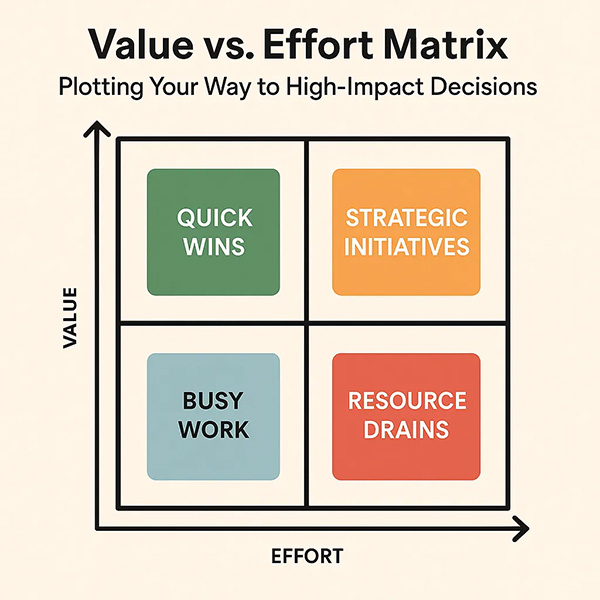
At EDSA, we help organizations bridge the gap between technology decisions and business outcomes.
Our operational assessment process starts with the P&L: identifying inefficiencies, delays, error rates and manual interventions that erode profitability. From that baseline, we build a prioritized roadmap of AI and automation opportunities, evaluating each initiative based on strategic impact, economic value, feasibility and risk.
The result is not a list of use cases. It is an investment case with measurable objectives, aligned with the business outcomes that executive teams and CFOs care about most.
Mckinsey souce: From promise to impact: How companies can measure—and realize—the full value of AI.
Gartner source: How to Identify, Fund and Measure High‑Value AI Use Cases.
Is your organization evaluating AI investments with the same rigor applied to any other capital allocation decision?
Learn how the EDSA AI Bootcamp helps leadership teams identify, prioritize and validate high-value AI opportunities before committing resources.
Reach out at talk@edsa.com and we will define a starting point.