Gartner 2026: Where the Conversational AI Market Is Headed
Gartner published its 2026 Magic Quadrant for conversational AI. Trends, investment, and what to check before choosing a platform.
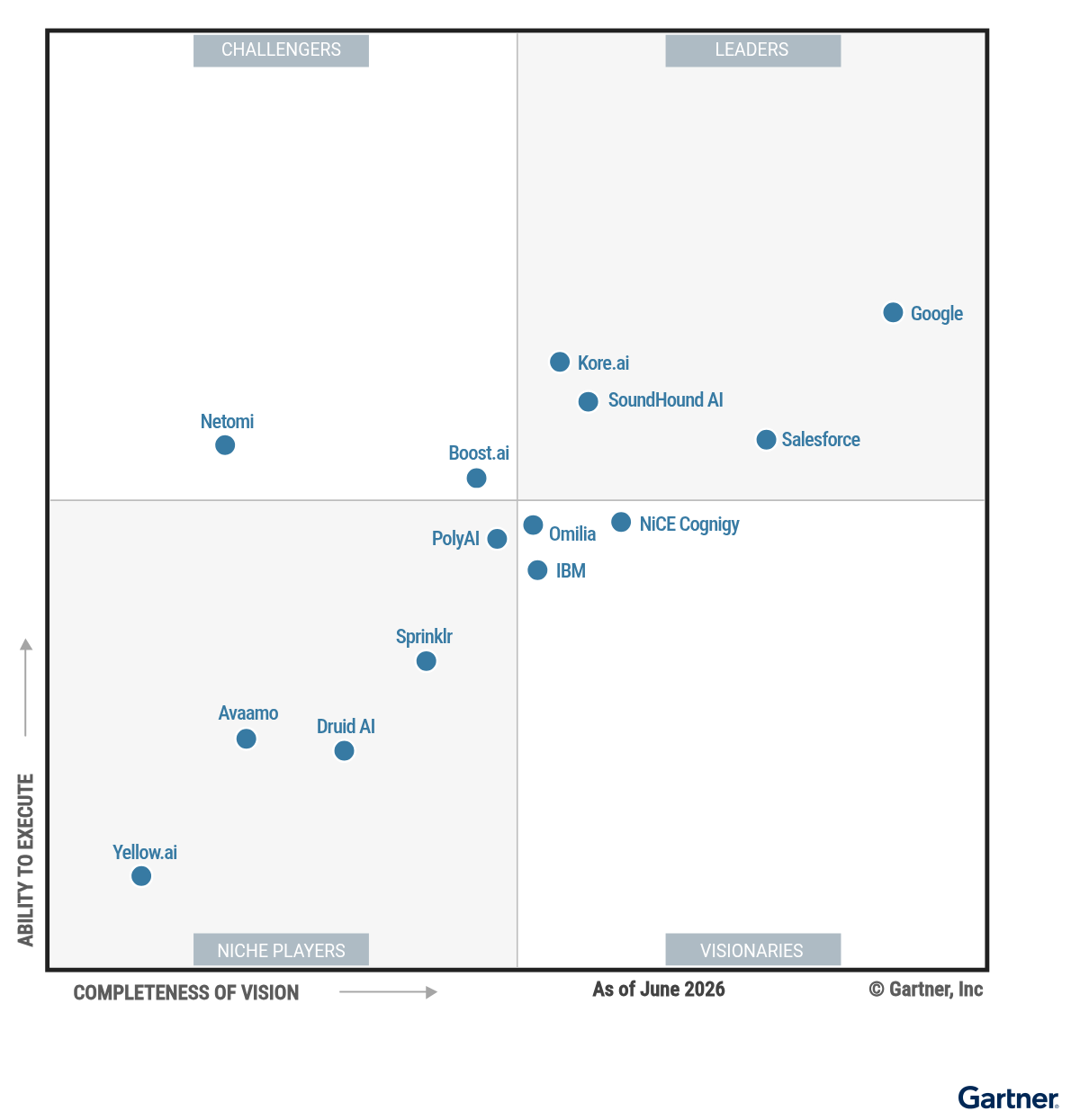
Gartner recently published the new edition of its Magic Quadrant for Conversational AI Platforms, which evaluates the leading providers of conversational AI technologies based on their ability to execute and completeness of vision. The report offers clear signals about where the market is heading and what to look at before choosing a platform.
Image: Magic Quadrant for Conversational AI Platforms
Google, Kore.ai and Salesforce were placed in the Leaders quadrant, the highest in the report. All three share the same profile: mature platforms, with sustained product investment and a consolidated presence in the enterprise market. That shared leadership, together with the presence of other major technology providers in the report, confirms that the conversational AI market is entering an early stage of maturity.
The report identifies shared investment areas among the leading providers. The most significant is the advance of agentic AI, with communication protocols between agents that enable coordination of complex tasks across different systems. Multimodality is also growing, with support for text, voice, image, and video within a single conversation, and early self-building and self-learning capabilities are starting to appear, where platforms adjust and optimize agents automatically based on the data they collect.
For companies evaluating this type of technology, Gartner highlights a few key criteria:
The conversational AI market is no longer defined solely by how innovative a product is, but by the ability to sustain that innovation over time, with solid governance, predictable costs, and continuity amid a context of accelerated consolidation. Before choosing a platform, it’s worth looking beyond the features and also evaluating these operational aspects, which tend to determine the long-term success of an implementation.
If your company is evaluating this type of technology and needs to clearly define which provider and which implementation model best fit its reality, at EDSA we can support you through that analysis and selection process. Let’s talk.
Reach out at talk@edsa.com